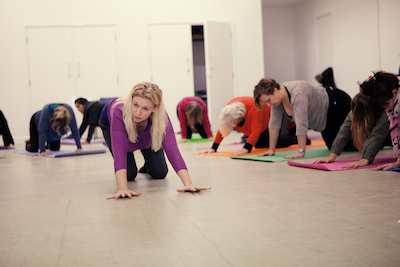
About the class
There are three intakes each year: January-March, April-June and September-December. There are five live discussion dates to complete, new date choices will be added all the time.
Course description
This course has been designed as an explorative journey for yoga teachers, yoga therapists and others to delve into how a compassionate and subtly attentive relationship with their bodies, practice and teaching can help address these commonly seen dis-ease states. This may be as a route to unravelling their own states and/or supporting those in students. There will be inclusion of Somatics practices – from the work of Thomas Hanna that emphasises internal physical perception and experience – and sits well within yoga to support modern body needs.
The courses will be held in ways that ensure safe and intimate group dynamics, with needs of the individuals attended to. Other movement teachers and wellness practitioners are welcome to apply if they have at least a year’s yoga practice.
A large part of this exploration will be modern stress and trauma, and what this means for our bodies, minds, yoga teaching and practice; on and off the mat. Charlotte Watts gathers together strands of her courses on Teaching Yoga for Stress and Burnout, and for ME/Chronic Fatigue (for Yogacampus) and her recent books Yoga Therapy for Digestive Health (Singing Dragon 2018) and The De-Stress Effect (Hay House 2015), for an experiential dive into how we can view symptoms of 21st century living through the lens of the Yoga Model of Wellness.
Each of the 10 themes (released fortnightly and listed below) includes the following:
Two 25-40 minute video presentations with illustrated slides covering the content
PDF documents of the presentation slides to refer to as you watch or makes notes on as you need
Extensive notes covering parts of the presentations in more depth, including self-enquiry exercises and the home exploration to guide deeper experience of the practice; suggested reading/self-enquiry/practice
60 minute practice video – this will bring in asana, somatic practices (eg from Thomas Hanna, Feldenkrais and Tias Little’s SATYA training), breath consciousness, sounding/mantra and meditation
either 60 minute live session – weekly online with two time slots to choose
or 2 hours meetup in person every 4 weeks (as Covid restrictions allow in the future) Brighton or London
COURSE CONTENT – 10 themes
Each of the themes below will be explored within the above format:
1. Arriving – Setting our community healing space. Where we find ourselves in modern life and what it means to be a ‘modern yogi’ in a world of goal orientation, high expectation and physical ideals. How these considerations can be supported by the yoga model of healing and recovery, as distinct from the reductionist model of disease.
2: Context of the Modern World – The stress response and what it means for the modern yogi – the effects of modern life and psychosocial stress on the nervous system, noticing polarities, somatic practices, survival over growth. Bringing in the yamas and the gunas as guides for practice and life.
3: Vagal Connection – Trauma & polyvagal theory – the freeze response, grounding, orientation and what this means within practice on and off the mat. The importance of the vagus nerve and old/new vagal tones.
4: Belly Connection – The enteric nervous system aka ‘second brain’ and listening to ‘what is true right now’, as well as sense of safety, intuitively responding and embodied awareness. Observing separation of head and body in reductionist culture; coming back to ‘head, heart and hara’ as whole.
5: The Fascial Web – Fascia as a sensory organ and how everything is connected to everything else. Communication via the psoas and fascia for kinaesthesia; interoception and proprioception, and how tightness, lesions and distortions in this matrix can ripple through the nervous system and affect how we move and feel.
6: Posture & Self – Modern postural habits from stress, sitting on chairs and trauma patterns. Including exploration of the primary and secondary spinal curves, the ventral and dorsal aspects (front and back body) and expressions of these via breath tones, and the Deep Front Line (Anatomy Trains) and sense of self.
7: Body Psychotherapy – Modern chakra theory & developmental trauma models for body psychotherapy – relationships with survival, trust, attunement, attachment and autonomy and how they affect our expressions through responses, gestures and movement.
8: Mindful Language – Stress, trauma & hypervigilance language – the modern habits of goal-oriented and self-critical language; how this affects yoga practice and teaching. The language of modern mindfulness as a helpful guide; inviting movement rather than imposing our will and the support of sound during physical practice.
9: Health as Whole – The yoga model of wellness (as opposed to the medical model of disease) and approaching health as coming back to whole, the root of the word ‘healing’. Discussing the kleshas (hindrances) as obstacles to wellness and sources of dis-ease within yoga philosophy. Identification with illness as a state and finding our essence nature.
10: Bringing it all together – Bringing it all together – gathering together the threads of the course to review aspects of whole health covered – in the context of moving beyond stress, trauma, burnout, anxiety, fatigue and post-illness through embodied awareness.
Pricing options
There are options to either pay in instalments or for less in full.
Please get in touch with Charlotte directly at info@charlottewattshealth.com if you are low income or a concession to arrange further discount.
Breakdown of the 80 hours course CPD hours:
Each of the 10 themes:
2 presentations – c.1.5 hours
Practice – 1 hour
Live discussion – 1 hour (dates available below)
Reading – 2 hours
Home exploration – 1.5 hours
= 7 hours per fortnight
+ 10 hours assessment
UPCOMING COURSE DATES – online live discussions
Here are dates for the next available course intake*. The ten live discussion sessions for each theme (60 mins) will be choice of either of these time slots (all dates for each):
Tuesdays 2pm UK time 2021 - April 20, 27. May 4, 11, 18, 25. June 8, 15, 22. July 6.
Thursdays 7.30pm UK time 2021 - April 22, 29. May 6, 13, 20, 27. June 10, 17, 24. July 8.
If you can’t make one of those dates in your chosen group, you can always attend the other for that theme or catch up within a future intake to ensure you have covered the required hours for the course.
You can sign up to the online course any time before these dates to access part 1 of the course and to start the foundational somatic practice and laying out the ethos for the journey.
*there are three intakes a year: January-March, April-June and September-December
Info & book -
www.charlottewattshealth.mykajabi.com/yoga-somatics-health-recovery
** PRACTICAL BITS **
Due to the nature of the Crescent Bakery building, it's ideal to wear layers of clothing for cooler / warmer fluctuations.
If you're looking for somewhere to stay near the studio, click here for info.
Please note workshops will be refunded only if we can find someone to take your place. Obviously, we will take account of exceptional circumstances.
If you have chosen to pay in instalments, payments to completion will still be due.
Please contact studio@orangeyoga.co.uk and we’ll be happy to help.